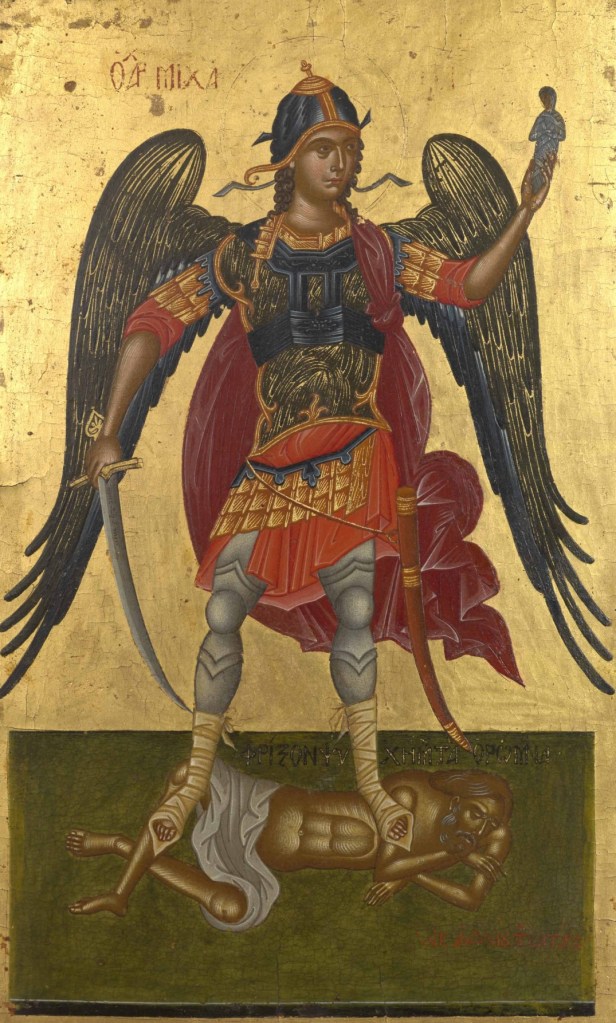
From today’s secondary feast of St. Michael the Archangel (September 6th) until our primary patronal feast of the Synaxis of St. Michael and All the Bodiless Powers of Heaven (November 8th), there are exactly 64 days.
64 is a good number! It’s 8 times 8, and eight is the number of the Age to Come, the eternal and Eighth Day to be inaugurated after the Second Coming and General Resurrection – at the end of the “seven days” of this creation.
This year, we’re also celebrating the 110th anniversary of our parish’s founding, and we’re preparing for Bishop Benedict to visit us on Sunday, November 1st, a week before our parish feast.
With all this in mind, and given Fr. Herman’s two recent homilies about the life of our parish, our challenges, needs, and hopes (which you can listen to here and here), Fr. Herman is asking all our parishioners and friends to offer a brief prayer to the holy Archangel Michael every day between now and our patronal feast on November 8th, asking for St. Michael’s continued protection and intercession for this beautiful parish named in his honor.
Holy Archangel Michael, spread the wings of your heavenly protection over your holy church in Mishawaka! Intercede for its parishioners and clergy, and all its visitors, friends, and supporters. Deliver us from the wiles of the devil, direct us in the path of good works, and lead us in singing the Thrice-Holy Hymn to the glory of God, the Father, the Son, and the Holy Spirit, unto ages of ages. Amen.
September 6th is a lesser-known feast of our heavenly patron, St. Michael, the Chief Commander of the Bodiless Hosts. Following on from last Sunday’s homily that surveyed some of the past triumphs and present needs of our parish, today’s Gospel about the two greatest commandments inspires us to ask: What is the purpose of a parish church anyway? And how are prayer and service to be lived out in our life together at St. Michael’s?
All those who regularly or occasionally worship with us at St. Michael’s are warmly encouraged to listen to this sermon as well as the one from last week.
This year St. Michael’s is celebrating its 110th anniversary. When a parish turns “eleventy,” it’s a good opportunity to pause and reflect on where we’ve been and where God may be inviting us to go. Fr. Herman’s homily from August 30th explores some of the triumphs, challenges, and needs of our parish, as viewed through the lens of the parable of the wedding banquet and its many invited guests (Matt. 22:1–14).
All those who regularly or occasionally worship with us at St. Michael’s are warmly encouraged to read or listen to this sermon as well as the one from the following week.
Homily for the 15th Sunday after Pentecost: the Parable of the Wedding Guests(Aug. 30th, 2026)
Fr. Herman Majkrzak
BROTHERS AND SISTERS, this parable of the wedding banquet we’ve just heard comes in St. Matthew’s Gospel immediately after the parable we heard last week about the unworthy tenants of the vineyard. Both parables were given by our Lord in the last week of his life, as the conflict between him and the religious leaders was heating up to boiling. As I mentioned last week, it’s therefore fitting that we encounter these parables in the Sundays leading up to the Feast of the Exaltation of the Cross, which will be two weeks from tomorrow.
But it’s particularly fitting that we hear this parable about the wedding today on August 30th. Yesterday, August 29th, was the feast of the Beheading of the Forerunner, St. John the Baptist. And this feast is so important that it’s actually two days long. Today is what we call the “afterfeast” or “post-feast.” And when it comes to weddings, St. John the Baptist has something to say. He called himself the “friend of the Bridegroom” (Jn. 3:29). (That word “bridegroom,” you may know, is what we mean when today we say “groom” – in other words, the man who’s getting married.) St. John said that Christ is the Bridegroom, he’s the man getting married: he’s marrying his Church, his Bride. But St. John said about himself that he is the “friend of the Bridegroom,” what we might today call the “best man”: the one responsible for making sure that everything at that wedding goes well, that it’s a good and joyful experience for everyone.
Now I said that the Church is the Bride of Christ. That’s probably an idea familiar to us all. But we can also say that the Church is the “wedding hall,” the banquet hall. It’s where the party happens. “Blessed are those who are invited to the marriage supper of the Lamb” (Rev. 19:9). This party, this banquet, is the Eucharist, the celebration of thanksgiving and communion that in the Latin tradition is usually called “Mass,” but which here in the Byzantine rite we don’t call “Mass” but rather “Liturgy,” more fully “divine Liturgy.” And of course there are other important services as well, like Vespers, Matins, Compline. But Liturgy is the most important, because it’s here that we are the guests of Christ at his wedding banquet. And the food that is served to us is Christ himself: his holy and life-giving Body and Blood.
Today, brothers and sisters, I’d like to reflect with you on the kind of “banquet” that is prepared and offered at least once a week here at St. Michael’s. I said that the food of this banquet is Christ himself, and so in that sense whether you’re here at St. Michael’s or down the road at St. Monica’s or St. Joe’s or any other Catholic parish in this area or throughout the whole world, it is the same banquet that you’re attending: the same food, the same spiritual nourishment.
And yet we also see how there can be great differences in the way this mystical Food is prepared, the way it’s served, the way we celebrate and sing and dance and show our love for our beloved Bridegroom. Obviously at any banquet the food is the most important element, but it’s far from the only element. St. Michael’s belongs to one of the many Eastern Catholic churches that exist throughout the world and that are in full communion with the Pope and thus with the entire Catholic Church, including the Roman Catholic Church. In this part of the world, if you say you’re Catholic, most people assume that you mean you’re Roman Catholic. And yet, starting a hundred and ten years ago, St. Michael’s has existed here in Mishawaka, amidst a densely Catholic population, as a reminder that there are other ways of being Catholic Christians besides the Roman way.
I said 110 years ago. We haven’t said a lot about this yet, but this year, 2026, is our 110th anniversary. We were founded in 1916. This is a good thing to mention now, because next Sunday is one of our two patronal feast days: Sept. 6th is a minor feast of St. Michael the Archangel—his major, principal feast is November 8th, which is also on a Sunday this year. So this building is 110 years old, and so is the rectory.
This beautiful church was planted here by Eastern Catholics, specifically by Greek Catholics, and more specifically by people who at the time referred to themselves as “Hungarian Greek Catholics,” not because they were from what today we’d think of as Hungary but because they came from what was then the Austro-Hungarian Empire, which included Ukrainian regions as well. Why did they come to Indiana? We could delve into the historical and economic currents that brought so many waves of Eastern European immigrants to America in the early 20th century. But I believe there is a deeper reason. They came here because the Holy Spirit was inviting them to do so. It says in the very last chapter of the Bible: “The Spirit and the Bride say ‘come!’” (Rev. 22:17). I think the Holy Spirit was saying to the founders of our parish, “Come to a new land, where there are already a lot of Catholics, but come and build a banquet hall where they will be able to see a different way of being Catholic. Come and fill this wedding hall with beauty and joy and prayer and love.” And that’s exactly what they did!
And it can’t have been easy. Not just because of the social and economic challenges of migrating to a new continent. But also because of profound limitations in what the Catholic Church in America was able to offer. At that time there was only one Greek Catholic bishop in the entire country, Bishop Soter Ortynsky of Philadelphia, and he died the same year our church was founded: 1916. His successor didn’t arrive until eight years after Bishop Soter’s death. (His name was Metropolitan Constantine Bohachevksy.) Meanwhile, there was a lot of suspicion and even, unfortunately, hostility from some of the more powerful Roman Catholic bishops in America. Clergy were scarce, support was scarce.
And so what happened here at St. Michael’s? You may not have known this, but early on in our parish history, St. Michael’s actually left the Catholic Church. It went into schism, it went into one of the Eastern Orthodox churches. And St Michael’s was not alone in this. In the early 20th century, there were in fact dozens and dozens of Greek Catholic churches in America that did the same. But – and this is really amazing – St. Michael’s came back. And I’m not personally aware of any other church that did that. In the mid-60s, through what can only be described as a work of God’s Providence, many of the parishioners here perceived a call to return to full communion with the Catholic Church. It wasn’t easy; there was disagreement and even legal battle. There was great personal sacrifice on the part of one of the families who are still active in our parish, the Cacarabs. But there again, what was behind all this? I believe the Holy Spirit invited them. “Come, fill my wedding banquet with guests. Those whom I first called left and went into another church. But my Catholic Church in Mishawaka still needs to have Eastern Catholicism as a jewel in its crown. Come back and let us feast together!”
Between then and now, over these last sixty years, there’ve been a lot of changes here. There was a major fire inside the church in the 70s, requiring major renovations, an entirely new iconostasis and altar. There’ve been other ups and downs. There hasn’t always been a priest in residence, but rather someone might come from Chicago every weekend. My predecessor, dear Fr. Volodymyr, did this for eight years. That meant that lay people who loved St. Michael’s really had to step up and keep things going. It’s not much of an exaggeration to say that this parish is still here today because of the sacrificial and heroic love of three couples in particular. Two of those couples are still with us; and the third, Richard and Joan Brown, both died fairly recently. We’ll have prayers for the one-year anniversary of Richard’s death towards the end of September. But these three couples responded to God’s invitation with great dedication and fervor,
And so many others in more recent years, and even in this past year since I arrived just over a year ago, offer so much to this place. I am filled with gratitude for the love that so many people have for St. Michael’s.
But also, like St. John the Baptist, I, as the parish priest, take the roll of the “friend of the Bridegroom.” I too must say “Come!” I must repeatedly say “Come! Fill God’s banquet house; fill the table’s at Christ’s wedding supper!” — this wedding supper that, in the most important sense, is exactly the same banquet as is served at every other Catholic church in the area, but which, in so many other ways that are also very important, is unique: a banquet that only St. Michael’s can offer. “Come!” The difficult days of the covid pandemic – during which many stopped coming to St. Michael’s, and some have never returned – those days are now long past. “You are invited!” Over the past few years there’s been a huge increase of interest and love for Eastern Christianity throughout America, especially among young people. This as our opportunity to show the fullness of our Byzantine tradition celebrated and offered not in schism but in full communion with the one Catholic Church. “Come!”
And, as the friend of the Bridegroom, I see many ways in which this banquet can be more full, so many jobs that need doing, so many tasks that need dedicated, reliable, and consistent hands prepared to welcome the wedding guests, week in and week out: ushers to welcome them and help them get oriented; cantors to lead the singing and even provide a four-part choir; sacristans to make sure everything is in order and in place before each service; altar servers to add solemnity and decorum to the celebration and to assist the priest in his work; people to collect offerings; people – it should be at least two, ideally three – to count and record what has been offered and get it to the bank; catechists to begin teaching our little ones and forming them in our own unique way of being Catholic; church cleaners and kitchen cleaners and basement cleaners and garage cleaners; ironers and launderers and florists to make this wedding hall pristine and lovely and radiant every Sunday, every feast day, week in and week out. Interior designers and landscapers and architects to restore and renovate and add to our building structures so that we have room to do everything we need – which we currently lack.
And this all is much more than the work that three couples or even six couples could do, however dedicated they might be. If there are between fifteen and twenty adults who come to St. Michael’s consistently, every single week, except when they’re out of town, even that is hardly enough, especially seeing how several of them have very young children with all that that entails.
But if we factor in all that people that come St. Michael’s twice a month, even once a month, even once every two months: this number is now far more than fifteen or twenty. It’s more like a hundred or 150. Perhaps some of them – perhaps some of you – are hearing a call from the Holy Spirit today: “Come! Make my banquet hall full! Even if you were not born and raised as Greek Catholic – or even if you were, but have mostly forgotten what that’s all about, or never quite knew to begin with — come! Be my guests! But also, welcome my guests. Prepare the banquet hall for them. Come, let us sup together” says the Lord. Amen.
The Feast of the Dormition of the Mother of God is this Saturday, one of the twelve Great Feasts of the liturgical year, arguably the most important and most beautiful of the Feasts of Our Lady.
All are invited to celebrate the feast at St. Michael’s as fully as your schedule may allow, with:
Great Vespers and Litya, Friday, Aug. 14, 6:15 PM
Festal Divine Liturgy, with blessing of flowers and herbs, Saturday, Aug. 15, 10 AM
Post-liturgy open house next door at the rectory (upstairs)
You’re encouraged to bring family and friends, especially those with a special love for the Mother of God and who may have never been to St. Michael’s before!
The glorious feast of the Dormition of the Most Holy Mother of God is sometimes called the “Summer Pascha.” For indeed, with this feast, we celebrate our Lady’s participation in the Paschal mystery of her Son, our Lord Jesus Christ—his death, resurrection, and ascension. Although not divine, Mary was conformed to this pattern of her Son: she died (this is what word “dormition” means), she was raised from the dead (as the firstfruits of the general resurrection that we all await after the Second Coming), and she was translated (that is, “assumed”) body and soul into heaven.
As Pope St. John Paul II taught in a catechesis on June 25, 1997:
“Involved in Christ’s redemptive work and associated in his saving sacrifice, Mary was able to share in his suffering and death for the sake of humanity’s Redemption … To share in Christ’s Resurrection, Mary had first to share in his death.”
In the same catechesis, John Paul notes the witness of the Fathers:
“St Modestus of Jerusalem (†634), after a lengthy discussion of ‘the most blessed dormition of the most glorious Theotokos,’ ends his eulogy by exalting the miraculous intervention of Christ who ‘raised her from the tomb,’ to take her up with him in glory (Enc. in Dormitionem Deiparae, nn. 7 and 14).
“St John Damascene (†704) for his part asks: ‘Why is it that she who in giving birth surpassed all the limits of nature should now bend to its laws, and her immaculate body be subjected to death?’ And he answers: ‘To be clothed in immortality, it is of course necessary that the mortal part be shed, since even the master of nature did not refuse the experience of death. Indeed, he died according to the flesh and by dying destroyed death; on corruption he bestowed incorruption and made death the source of resurrection.’ (Panegyric on the Dormition of the Mother of God, n. 10)
Tomorrow—the week after All Saints’ Day—is celebrated as the Feast of All Saints of Rus’-Ukraine, a joyful day for us to honor the thousands of saints that have graced the Church in Ukraine since its establishment in Kyiv over a thousand years ago, and to ask their intercession for the Ukrainian people today, both at home in the midst of the Russian invasion, and all over the world, including our own parish.
To celebrate this feast, we will be using somewhat more Ukrainian than usual. We’ll sing “Only-begotten Son,” the Cherubic Hymn, “It is Truly Right,” and “Let our mouths be filled” in Ukrainian, and Brian is graciously providing transliterations, so you can sing along even if you don’t read Cyrillic.
In addition to modern Ukrainian, the priests will also take a few litanies and exclamations in Slavonic.
Slavonic is the liturgical language that was developed by Sts. Cyril and Methodius as a fitting vessel for translating our original Greek scriptural and liturgical texts. It still remains the official liturgical language of the UGCC, even though it’s now much more common to use modern Ukrainian. Since it’s the language used for prayer and worship by the vast majority of the saints we’ll celebrate tomorrow, it’s good and appropriate for us to use at least a little of it ourselves.
One other thing for tomorrow: the 1st and 3rd Antiphons (towards the beginning of Liturgy) will be different than usual. During the Apostles’ Fast and other Fasts of the liturgical year, we will be using what are called the “Typical Psalms” and Beatitudes. This means that at the first antiphon, we’ll sing Psalm 102 (103), a psalm about God’s mercy and love for sinful and weak humanity. And for the 3rd antiphon, we’ll sing the Beatitudes – Christ’s words from the Sermon on Mount in Matthew 5 listing the virtues and qualities that we strive to cultivate as children of the Kingdom.
➤ Thursday, Moleben to our Lord Jesus Christ, the Lover of Mankind
We will offer this Moleben on Thursday evening at 6:15, the eve of the Feast of our Lord, the Lover of Mankind (i.e., Sacred Heart). If you have names of the living you would like us to pray for at this service, please email them to me, or write them on a slip of paper before the service.
➤ Summer Opportunities for You and Your Kids!
• 1. Every summer, the Ukrainian Catholic Eparchy of St. Josaphat hosts the All-American Youth Conference – Всеамериканська Молодіжна Проща, in Parma, Ohio, June 11–14. Це особливо гарна можливість для україномовної молоді!
“Друзі, раді анонсувати програму прощі! На вас чекають 3 незабутні дні в колі прочан —час молитви, радості та глибокої зустрічі з Богом і один з одним.” — “Friends, we are excited to announce the pilgrimage program! You can look forward to 3 unforgettable days among fellow pilgrims — a time of prayer, joy, and a deep encounter with God and one another.”
More details are here and (Українською мовою) on Facebook here.
• 2. The Metr. Andrey Sheptytsky Institute, in Toronto, Canada, is hosting its annual Study Days, June 19–21, on the theme “The Gift of Monasticism.” I will be there and speaking on the theme: “Revealing of Thoughts, ‘Mental Hygiene,’ and Being Vulnerable with God”. More information and registration is here.
• 3. The Byzantine Catholic Eparchy of Parma is hosting its Annual Family Liturgy & Life Camp, August 9–14, at Cedar Lake, Indiana – a week of liturgical prayer, catechesis, and recreation.
“Bring your family for a joyful week of prayer, play, and community at our Family Liturgy & Life Camp! This year’s program is built around the four ‘ships’ from Bishop Robert’s Christ God Our Hope: Discipleship, Worship, Fellowship, and Stewardship. With age‑specific morning sessions, afternoons full of recreation, and evenings gathered in prayer and fellowship, it’s the perfect blend of faith and family fun.”
This is a great opportunity to get to know other Greek Catholic families (of various traditions, Melkite, Ukrainian, Ruthenian…). Our good friend Fr. Andrew Summerson is the chaplain. It’s possible that I may be there as well — yet to be determined. More info here and on Facebook here.
On Saturday, 5/2, will we have a special parish vespers at 5:30pm. An explanation will precede the service at 5:20. All are invited and warmly encouraged to attend!